
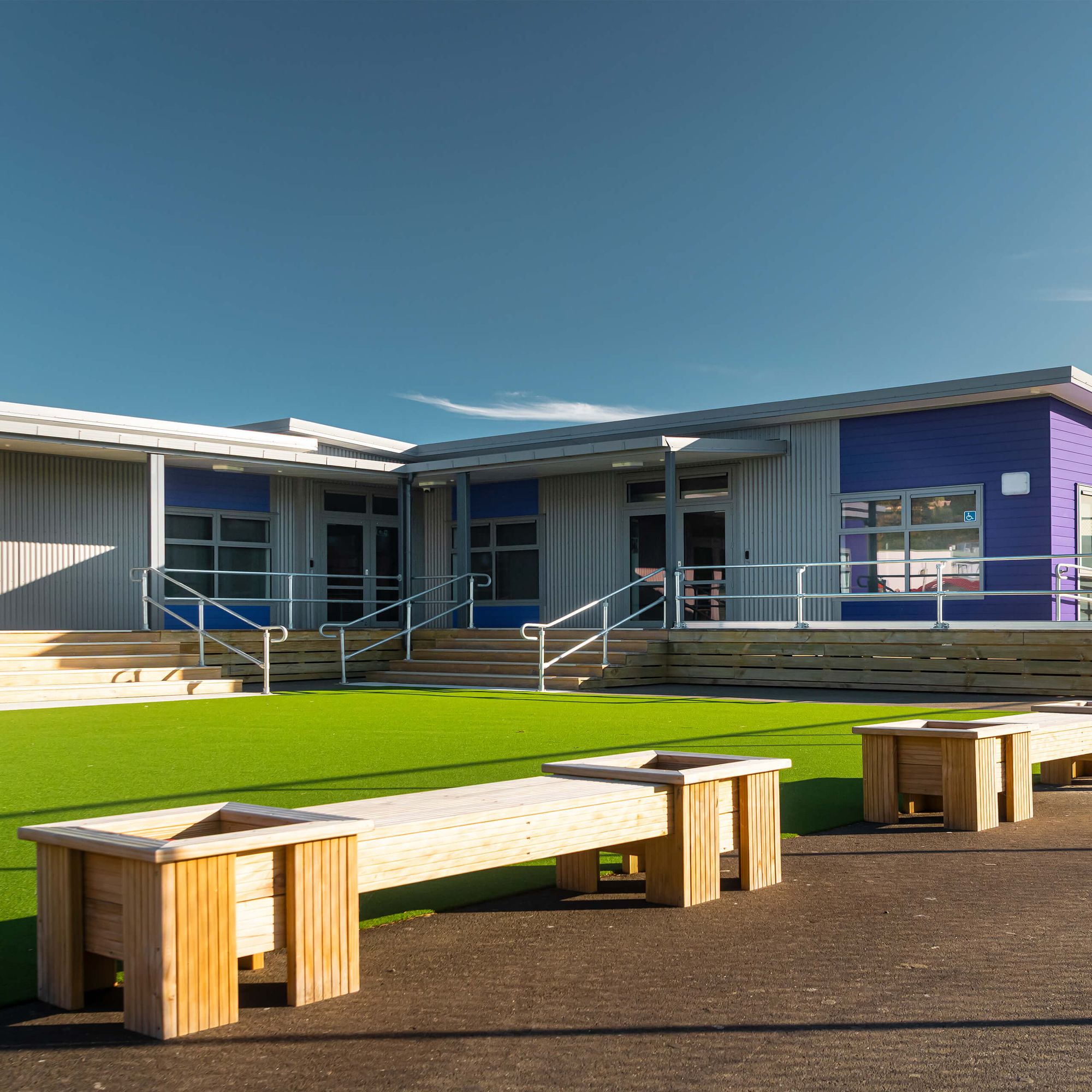
Climateline helps throughput on Niche Modular’s education builds
For Petone-based Niche Modular, the project aligned well with its modular approach. The company—now New Zealand’s largest modular builder—focuses on delivering 95 per cent of each building offsite. This factory-first strategy enables greater consistency in finishes, quality assurance and speed to site.

“If we can build it in the factory, we will, whether it’s a deck, a stair, or something custom,” said Rick Bell, Business Development Director at Niche Modular. “The goal is always to reduce what needs to be done onsite and improve overall efficiency.”
For Mahinawa, Niche used ClimateLine prefinished plasterboard from Climate Surfaces for all internal wall linings. Designed for prefabricated construction, ClimateLine’s coated GIB substrate removes the need for plastering or painting, reducing both labour and drying time.
“For us, it was the efficiency of being pre-finished while maintaining acoustic value,” said Bell. “It’s glued, not nailed—simple, clean, and it removes trades from the equation.”

Bell estimates that using ClimateLine has led to a significant reduction in internal wall costs compared to traditional methods. “We’re saving around 30 per cent by eliminating fixing, stopping and painting,” he said. “There’s less waste too—everything is cut precisely, and we only trim for skirting.”
That level of simplification matters in modular construction, where the sequencing of factory-based trades must be tightly managed. For Niche, ClimateLine’s prefinished nature contributes to consistent throughput in its Lower Hutt facility, which spans more than 3,500 square metres.
“You don’t want painters and stoppers coming into your factory when your core objective is flow-line production,” Bell said. “It’s quicker, cleaner and reduces rework.”
Mahinawa School’s modules were fully lined, with joinery and services installed prior to transportation. Because the boards are factory-finished, they eliminated the risk of paint cracking or surface delamination during handling and installation.
“Because we’re transporting fully lined modules, we needed a wall finish that would hold up across multiple movements and installations,” Bell said. “We’ve tested other systems, but ClimateLine consistently holds up. No delamination, no cracking, just install and move on.”
The relationship between Niche and Climate Surfaces dates back over seven years, originating from an earlier phase of modular development that preceded Niche Modular’s current structure. That foundation laid the groundwork for ongoing collaboration and has seen ClimateLine become a core part of Niche’s internal fit-out strategy.
“We see ClimateLine as a product that aligns with the offsite methodology,” Bell said. “It’s all about simplification and precision.”
To manage compliance, quality and construction tracking, Niche uses a cloud-based documentation platform that supports both factory and site operations. The system enables digital sign-offs and photographic inspection workflows in place of on-site checks.
“Our local council doesn’t even come to the factory because it’s all documented digitally,” Bell said. “All inspection phases are photographed, logged, and submitted as part of a structured approval process.”
That integrated workflow helps Niche maintain pace and control across multiple projects. The company recently completed Wellington Hills College in just 100 days—a 16-classroom build on a greenfield site.
“It’s unheard of, but it only worked because of the experience we’ve gained beyond traditional construction methods,” Bell said. “It’s things like site works, landing, and the people we have within the company—how efficient they are at design, construction, and the factory.”
While Mahinawa’s scale was modest, its delivery was no less complex. The requirement for hygienic surfaces, reduced trades and minimised site disruption made ClimateLine a natural fit.
With a Group 1-S fire rating and impact resistance suited to institutional settings, the product is designed for health, education and high-traffic environments. For modular builders like Niche, its benefits are magnified by the efficiencies of offsite fabrication.
The Mahinawa School project reaffirms how matching building methodology to material specification delivers both programme and performance benefits. For Niche Modular, it’s an approach grounded in practice.
“We’re not just building boxes,” Bell said. “We’re building systems that work.”
Partner content
Prefinished linings from ClimateLine support Niche Modular’s education builds